 |
Alicia Harvie
Put those Birkenstocks away – vegetarian cuisine has undergone a serious makeover. Thanks in no small part to California’s league of culinary innovators, vegetables have left behind their crunchy granola past to assume their proper place in haute cuisine. No meat, fish or fowl need apply.
According to the Vegetarian Resource Group, about three percent of Americans identify themselves as vegetarians. That number is on the rise, but may still belie the growing popularity of vegetarianism in general and the rise of “flexitarians” – individuals who occasionally go meatless for health, philosophical or political reasons.
Granted, vegetarian eating is not new to culinary history. Most traditional cuisines are highly plant-based, with animal proteins playing a small role, if any. But as the hottest players in California’s vegetarian scene prove, there’s nothing traditional about this trend.
The roots of the revolution
To pinpoint the birth of haute vegetarian cuisine, one need look no further than San Francisco. In 1979, Greens opened as part of the San Francisco Zen Center, a Zen Buddhist meditation center that regularly served vegetarian meals to its community. Situated in Golden Gate Park’s historic Fort Mason, Greens established what was and still is considered groundbreaking work: presenting cooking with vegetables as a cuisine in its own right.
Executive Chef Annie Somerville joined Greens in 1981, enticed by its forward-thinking approach. “There’s a certain honesty to our food. We’re not trying to mask our vegetables in layers of flavors or presentation. We’re celebrating them. Since its inception, Greens’ cuisine has been based on celebrating beautiful seasonal organic ingredients, as opposed to meat substitutes or bland food lacking texture and flavor. You know the stereotype: Brown rice. Tofu. Overcooked vegetables.”
With dishes that boast Mediterranean, Mexican and American Southwest influences, Greens has never felt limited by its meatless menu. “Many of our cooks aren’t vegetarian, so we don’t approach our dishes with assumptions about what vegetarians should eat. A big piece of our longevity is that we offer a broad range of dishes to a broad range of people. There’s something for everyone.”
So hot, they’re haute
With so many culinary trends making headlines these days, what makes veggie fare stand out?
“This is about vegetables coming into their own,” Somerville answers. “The whole world of vegetarian cuisine has really evolved. Vegetables have come to the fore.”
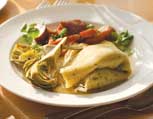
That’s evidenced by Greens’ Rosemary Crepe, a star on its menu. “Our rosemary crepe offers a combination of greens: rainbow chard, savory spinach, beet greens, and sautéed leeks or spring onions.” Seasoned with crumbled goat cheese, reduced cream, Meyer lemon zest, artichoke, mint, and of course, chopped rosemary, the dish is a veritable garden in and of itself.
Still, the trail Greens has blazed is undoubtedly fueled by today’s larger cultural context. Lee Gross, Consulting Chef of M Café, is a leader in macrobiotic cuisine. He sees its growing popularity as a reflection of the times.
“Eating organically, seasonally – these are buzz words on the forefront of the scene today. But they’ve always been the pillar of macrobiotics. It’s timely. That’s why it’s so popular.”
Gross explains that macrobiotics is “a diet, a philosophy and a way of life” that emphasizes whole grains and vegetables and eschews refined sugars, dairy and animal proteins. The appeal of macrobiotics, according to Gross, is rooted in contemporary political and ethical questions.
“How do we solve the challenges that exist around the environment and food? For myself, macrobiotics was a way to tie my values with my culinary background. I realized that our dietary choices are a driving force for change in the world. We really are what we eat. There’s a growing awareness of this.”
It’s also hard to deny the health appeal of vegetarian cuisine, which has inspired diners to embrace every corner of the vegetarian family.
“Raw food doesn’t get a lot of love in the vegetarian movement,” explains Rachel Carr, Executive Chef of Los Angeles’s Cru, a national beacon of raw vegan cuisine. “But right now there’s a lot of interest. There’s huge growth in terms of the quality of the food and dining experience people can have.”
Perhaps intimidating to the average eater, establishments like Cru are redefining raw food and broadening its appeal. With Carr at the helm, Cru leads the way in crafting gourmet raw vegan dishes that incorporate Italian, Japanese, Tunisian, Thai, and Indian influences for an eclectic audience.
“Most of our clientele are not ‘raw,’ but like to have this as an option,” Carr explains. “Some approach raw food for a short period of time to cleanse or lose weight. But, it’s hard to find good, satisfying raw food options. Our style and presentation are more romantic and refined than most establishments. Customers want a more elevated experience with raw, vegan food.”
Kicking “rabbit food” to the curb
So, should chefs interested in vegetarian cuisine fear being stamped with a “rabbit food” label?
No, says Gross. “There’s a misconception that it’s Spartan, but that’s not true. The number one priority for us is flavor and satisfaction.”
Skeptics should consider M Café’s premiere dish, The Big Macro. “It’s a huge hit on our menu. It contains all the essential food groups in macrobiotics: whole grains, vegetables that are slow- and fast-cooked, beans for protein, and pickled or fermented food to aid in digestion. The Big Macro has all that, but on a bun to play off the Big Mac. It’s reflective of what M Café is about – macrobiotic products in a form that’s recognizable and delicious.”
Chef Carr echoes the merits of that approach. “You’d think being a raw vegan restaurant, we’d sell a lot of salad,” says Carr. “But anybody can make a salad. The hits on our menu are the dishes people can’t make for themselves. We have our cheesecakes, our ravioli, our tostadas – things you can’t tell are made of fruits and vegetables. It gives our customers a way of relating to the food.”
To that end, Cru’s repertoire includes desserts even the most health-conscious can indulge in guiltlessly. “Raw vegan desserts are a great bridge for people who’ve never tried raw vegan food. They taste incredibly rich. We offer ice cream, raw vegan cheesecake, chocolate cake, brownies – you name it. Everyone loves it.”
Chef Robert Curry, Executive Chef at Napa Valley’s Auberge du Soleil, maintains that vegetarian entrees are anything but restrictive. “We’re sitting in the best place in the country to do vegetarian cuisine. Right now in springtime, it’s just amazing here. Blood oranges, asparagus, artichoke, wild mushrooms – they’re everywhere.”
Auberge remains a key culinary attraction in Napa since its launch 25 years ago, drawing from a broad array of regional produce, Mediterranean influences and a sommelier who boasts the best of wine country’s vineyards. “Vegetables allow our menu to move through the seasons,” Curry offers. “On the protein side, the options don’t change much, whether it’s squab, lamb or even suckling pig. But with vegetables, it’s endless, even within a season.”
It’s in that spirit that the restaurant has added its vegetarian prix fixe tasting menu, which pairs top wines with a select breed of gorgeous vegetarian dishes, like its Delta Asparagus Risotto seasoned with tarragon, shaved parmesan and yuzu emulsion. To Curry, these lighter options are smart strategy.
“What do you do in Napa Valley? You taste wine and eat. After a while, you get tired of it. Vegetarian options can be a relief to our customers – it’s easier on the stomach and palette.”
Getting started
“If you want to foray into vegetarian food, and you feel like you don’t have experience with it,” advises Chef Gross, “just pick a cuisine. Anywhere in the world – Italy, Mexico, France. Research what the indigenous vegetarian cuisine is. That will give you your context to launch from.”
Not surprisingly, chefs dedicated to vegetarian cuisine also emphasize the importance of strong relationships with their growers and purveyors.
“For myself and so many chefs,” says Somerville, “the major commitment is working with small growers.”
Chef Curry agrees. “Knowing your local farmers is key. They’ll keep your finger on the pulse of the garden. For example, I’m discussing our lettuce with our growers at Frog’s Leap Winery. At this point in the season, the lettuce grows so slowly that the flavor is incredibly developed. That will change in the summer when things go more quickly. You really need a good relationship with your source to understand the product.”
A shift into veggie fare, however, is not necessarily easy. But that hasn’t deterred this burgeoning movement one bit. “It’s a lot of work on every level,” Somerville adds, “but that’s what makes it fun and rewarding. I’m sure it’s been my mainstay at Greens.”
Alicia Harvie has been actively involved in food and farm issues for years now and has a strong interest in creative “farm to table” linkages in culinary culture. She also loves any and all things chocolate. When not freelancing, Alicia works as the Program Manager for Farm Aid (www.farmaid.org), where she pens its “Ask Farm Aid” column each month. Farm Aid's mission is to build a vibrant family-farm centered system of agriculture in America. Alicia can be reached at alicia.harvie@gmail.com.