 |
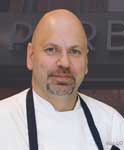
You Cook Because You Want
to Make People Happy
Interview by Sasha Berstein
How did you know you wanted to cook?
When I was ten, my aunt gave me a French cookbook that I loved; I grew up being interested in food and wanting to know more. So when I was 14, I got a dishwashing job to get into a kitchen, and I worked in a slaughterhouse eventually too. At the time, my home economics teacher told me I could probably do anything, but I’d never become a cook. At that age I was a pain in the ass. I ran into her years later at a train station in Stockholm and told her I was cooking at a Michelin starred restaurant – I think she almost fainted.
Why Italian?
I don’t know if I chose Italian or if Italian chose me. When I was 17, a friend and I took a summer off, got Eurorail passes and traveled through Europe – mostly in Italy. We got to Liguria and found a small side-street restaurant that felt very local. Four loud tourist families came in after we sat, and I think the owner felt bad for us, so he waved us to the back patio area where he and his family were having lunch. It was all family style – simple – I can’t even remember the pasta now, but it was amazing. That experience always stuck with me.
How did you meet your business partner Umberto Gibin?
I met Umberto in ’85 or ’86. I was working at a restaurant in Orange County, and they opened Prego across the street. Competition. Umberto was the GM; we went to try lunch there, so we were introduced. Then, when I was the corporate chef at Piatti in Mill Valley, Umberto was at Frantoio, and we’d go for lunch there, so we started to get to know one another. When I left, I started working at Scala’s and found out Umberto was the new GM at Grand Café. He and [his wife] Leslie would come into Scala’s for lunch on Sundays, instead of going to Grand Cafe, so he could have lunch without feeling like he was working. Then one day out of the blue, he called me from Poggio [his then GM position in Sausalito] and asked if I wanted to open a restaurant. He has incredible professionalism, and I felt I was ready.
Do you get to other chefs’ restaurants?
I’m not the type that’ll run to the newest restaurant. I tend to go eat at restaurants where my good friends are chefs, see what they’re doing. The sous go out all the time and try everything. It’s so important see what’s going on.
You have been frequenting Japan – what are you doing over there?
It started in 2009 with Sho [Kamio, of Yoshi’s] who I knew here and there from events. He was invited to come represent American chefs for a group of Japanese producers in Miyagi. Ravi [Kapur] called me and asked if I wanted to go to Japan. “Uh, yeah!” The group really bonded – Sho, Ravi, Paul Canales, Bruce Hill, a few others – all city chefs with so much in common, except Paul, who’s [in] Oakland, but we still accepted him. We were sampling their products – sake, miso, wagu beef, fish market items – they wanted our opinion on how to market to Western chefs. We had a lot of fun. A year later Sho was invited to cook at a big sake event there and asked me to be his sous. We ended up driving five hours to Tokyo in a van filled with food… pretty funny. It was a long night, but we had a good amount of playtime too. Now I’m going back again this month.
What’s your favorite thing to eat at Perbacco?
I don’t have a favorite dish… But what I’m really proud of at the restaurant, is that we don’t take any shortcuts. We always do things the hard way, from the beginning; there’s no magic formula. Every pasta is made by hand. We save the apricot pits, crack them [which isn’t always easy] and get the bitter almonds out for our amaretti cookies. We could just go out and buy bitter almond extract, but we don’t; we make things really hard on ourselves.
What trends are you seeing?
Gluten free! Which will be gone as quickly as it came in… Really though, this is going back to spartanism: find the soul and essence of what you’re cooking. Use the best, treat it with respect, and let the ingredients stand out on their own. After nouvelle cuisine, beurre blanc and vegetables pureed into oblivion, it was time to go back to natural. Chefs used to use just the center cut; now that’s almost frowned upon. Chefs are educating themselves on utilization. It’s horrible, but the downturn in the economy has made us all better cooks – and better eaters too.
How do you stay inspired?
I read about food every day – a new cookbook, an old one, a periodical, the food section – if I can get one thing that inspires me, or makes me a better cook tomorrow than I am today, then it’s worth it. It’s about the history, too. Not being Italian, it’s important for me to study, travel, eat, learn the region. The history and way of life play into the food. In Colonnata, Toscana, a town built on marble, lardo and anarchists [laughs,] I had a sandwich with at least 10 slices of lardo. Umberto looked at me like I was nuts. It was a lot, but the woman serving it told us that the men in the marble quarries take 20 to 30 slices. They are burning thousands of calories a day in those quarries, so they have to eat something rich in order to survive. It changes the way you think about making it. You have to understand the basis of the culture to understand the food.
How would you describe your relationship with your staff?
I always strive to be an inspiration to do the right thing, to be a mentor, to make people better at what they do, but most importantly to be caring about the individual and knowing that person. You cannot only be the boss, you also have to be able to listen and know the individual that does the work that you want them to do.
What advice would you give burgeoning cooks?
As a young cook, you usually want to use the whole color palette, as many ingredients as you can, in crazy combos; it’s great. It’s a necessary process in building creativity. But after cooking more, you start to distill down.
It’s challenging to limit yourself. I always think in threes. Take three ingredients and make the most of them – like fennel, orange and red onion, a classic combination. Break them down: fennel, you have the bulb, the seeds, the fronds, the flowers, the stem; orange, there’s the sections, pulp, juice, zest; onion has the bulb, greens, roots – all of a sudden there are 10 or 12 ingredients, and you still know what you’re tasting.
Is there a night of cooking that stands out in your? memory?
Sure there have been horror stories, which are the same for everybody. Highlights? It was great cooking at the James Beard House, going to New York, having a good time. The best was actually more of a time span. That was opening Perbacco. There were all these emotions, energy, exhilaration. I lost 30 pounds. When we started I was fat and happy, but there was just no time; we’d have 20-hour days all week and know it was going to be like that for the next six weeks, or more. But at the end of the day, I’d walk home with bags under my eyes and a smile on my face.
If you had unlimited capital to open a new restaurant, what would it be?
It would be very small. Probably no tables, just a counter, where you’re right there cooking for a small group of people every night. There would be one menu and it would change every day. Hard to make profitable, but that would be the most fun.
Then: Piatti, Yountville, Santa Barbara and as corporate chef in Mill Valley; Bistro Don Giovanni, Napa; Kimpton Hotel & Restaurant Group, Scala’s, San Francisco
Age: 49
Grew Up: Nyköping, Sweden
Education: Kristinberg Hotel and Restaurant School, Stockholm, Sweden
Self ID: “Chef” is a title; “cook” is what defines me
Often frequents: Chotto, Incanto, RoliRoti, Locanda, Aziza, Prospect, Ferry Plaza Farmers Market, San Francisco