 |
by Jeff Decker
As the fat melts in your mouth and the salt tingles your tongue, you know that you have hit an exalted level of culinary ecstasy. Salty, sweet, delicate, meaty yet refined: these are all attributes which we take comfort in with charcuterie.
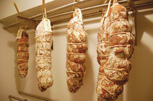
Charcuterie has its roots in the earliest periods of cookery as it was a method of preserving meat. A meal which encounters charcuterie stirs excitement for diners and breeds inspiration for chefs.
In today’s dining scene, charcuterie has not only become accepted but it has also been elevated as a bona fide selling point of the restaurant. Diners have grown to accept items such as duck liver and pigs’ ears along with other less common proteins such as rabbit or even pigeon as they continue to put aside their inhibitions. Charcuterie has hit the mainstream: It’s the stuff we read of in books and magazines and even celebrity chefs tout their virtues on television; you watch, hear, and you want to try it. But, there is an eminent feeling as a diner that you know you can’t try this at home – it is a genuine delicacy that must be handled by experts. Charcuterie fits into today’s nutritional guidelines too. As people tend to eat less meat, or make sure that the protein they do eat is of the highest quality, the smaller portions consistent with eating charcuterie can be reassuring.
To buy or not to buy?
For the chef who must decide whether charcuterie is right for his/her menu, there is a list of questions that must be answered. First, will it increase sales? Well, if being on trend means an increase in diners, then yes. Next, how extensive an offering needs to be made to present the category in a credible light?
Here, the style of charcuterie needs to be a good brand fit – it should not be out of sync with the cuisine, nor should it dominate the menu, but rather it should serve to complement the balance of menu items and flavors.
One of the greatest differentiating factors that the chef must decide upon is whether to buy or not to buy. House-cured meats can be a definite selling point for any restaurant as it takes a chef who is not only capable but also willing to create his/her own. Is it cost-saving? Yes, and no: It can use up meat scraps, therefore keeping food costs low, but demands a higher level of labor. Meanwhile, by sourcing out the items – from broad-liner to specialty distributor – the chef can rest assured that the item will be of a highly consistent and quality product.
Expertise embraces simplicity and tradition
At those restaurants that do serve house-cured meats, it is a testament to the chef’s hard work and expertise. It is such a fine craft that it requires “small batch production” similar to a fine wine or aged liquor. The chef who has created the charcuterie by hand has license to present it simply, without over-bearing flavors and with the inclusion of minimal additional ingredients. This is one element of the menu which should not be reinvented or tinkered with. At restaurants such as Oliveto in Oakland or Spruce in San Francisco, we see the “classical” Old World profiles of salted, cured and smoked meats remain the gold standard for the category. Chef Paul Canales at Oliveto highlights his Italian-inspired menu by creating refined salumi including crespone, mortadella, felino, and Toscano, among others.
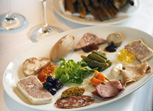
At the elegant and contemporary Spruce, Chef Mark Sullivan displays a polished touch with his charcuterie plate which includes items such as a classic French country pate, rabbit rillette with perigord truffles, pig’s ear terrine and foie gras mousse. Items such as pork rillette or foie gras served in jars at Chef Walter Manzke’s Church & State in Los Angeles serve to unify the menu and define the restaurant’s French bistro style.
For the majority of restaurants, from cafes to hotels and even Michelin-starred restaurants, whose chefs would rather source such fine meat creations, charcuterie can be used to fortify dishes or highlight flavors while also setting the tone for the menu and restaurant. Therefore, it is the job of the chef, especially the one who has brought in the ingredient, to bring it to life on the plate. The chef can show off his/her knowledge by serving it with accompaniments or in composed dishes. This can often still present a challenge, and we can therefore still accredit the chef who puts charcuterie on his menu with much acclaim.
Keep your guests and culinary team captivated
Charcuterie serves not only to attract the guest to the restaurant, it can also captivate a cook to come and be part of a kitchen. From a chef’s point of view, working in a kitchen where charcuterie is made is a great opportunity for the highest level of training and education in techniques that are not widespread. The soft-spoken and unassuming expert in his craft, Chef Sullivan’s face lights up when discussing his variety of cured meats, explaining that his kitchen will take in a whole pig, and not just any pig, but different heritages of swine, and grind, cure and cook the different cuts in a myriad of ways. Chef Paul Canales employs a small, tight-knit crew, which allows him and his team to give each product the same care and adoration which produces the most refined charcuterie every time.
Pairing of charcuterie with beverages such as wine or beer is a great opportunity for the sommelier. At Spruce, the charcuterie plate is paired with not one but three very different beverages. The first, a Veuve Fourny Rose Champagne; the second – a Riesling Spaetlese; and the third – the Duchesse du Bourgogne, a Flemish red ale. Each of these paired very succinctly with the different sweet, savory and salty flavors on the plate.
Whether or not the charcuterie is made in-house, the craftsmanship and skill that is the art of charcuterie will differentiate the menu and bring excitement to both the chef and the diner.
Jeffrey Decker graduated from UC Berkeley before training as a chef at Spago Beverly Hills and at small luxury hotels in both Ireland and Mississippi. He now works as a chef and project coordinator at The Culinary Edge in San Francisco where he has consulted on concept and menu development projects for the top chain restaurants in the country. He has also launched numerous new concepts while developing retail items for commercialization. Jeff@ TheCulinaryEdge.com
Recipes from:
Church & State, Los Angeles:
C&S Foie Gras Terrine
C&S Jambon Persille
Oliveto
Oakland, CA
(510)547.5356 • www.oliveto.com
Spruce
San Francisco, CA
(415)931.5100 • www.sprucesf.com
Church & State
Los Angeles, CA
(213)405.1434 • www.churchandstatebistro.com