
 |
Alicia Harvie
Bored by your beefsteak tomato? Take a look at California’s food scene. Today, it’s one of the hottest locales for chefs breaking the mold with heirloom produce and heritage meats.
While the definition of heirloom or heritage is debated, the consensus falls on varieties that have been bred, nurtured and passed down for several generations, if not centuries.
“You can feel the history of the food,” says Sean Baker, executive chef at Berkeley’s Gather, of the many heirloom varieties showcased on his menu. “In the 1950s, our whole culture changed with the introduction of fast food and pre-made meals. Our grandmothers probably knew more about food than most of us do now.”
Indeed, the 1950s saw the development of industrial agriculture, which slowly narrowed seed and animal varieties available on the farm. For example, all hogs were once raised outdoors, where they developed a thick layer of back fat to regulate their body temperatures. Once the animal’s most valued trait, it acquired a stigma when the low-fat fad hit popular consciousness. Kelly Biensen, General Manager of Eden Farms explains, “In this world of super-lean hog breeding, it is very important that we maintain her itage breeds, which are more tender and juicier than factory farmed meat. It will become more important for chefs and consumers to realize the value of heritage breed meat, so that the farmers will be able to keep the genetics alive for chefs and other consumers in the future.” New breeds, bred for as little fat as possible, eroding the species’ genetic pool and sending tons of traditional knowledge and flavors into oblivion, is exactly what Biensen and his team at Eden Farms is trying to protect against.
Thankfully, today’s resurgence of heirloom and heritage varieties aims to buck this trend, inspiring innovation in the kitchen along the way. California’s geography, filled with several microclimates and ecological niches, boasts a staggering number of heirlooms and heritage animals, making it a natural place for the trend to take off.
A flavorful venture
Farmers and ranchers often prefer heirlooms and heritage breeds for their resistance to local pests and hardiness in extreme weather. For the chef, the benefits come in the form of flavor. “Different animal breeds have different fat marbling, for example,” says Executive Chef Guillaume Bienaimé of Menlo Park’s Marché.
“When we get tired of doing the same old thing, heritage breeds offer a great way to differentiate.”
Brady Lowe agrees. So much so that he launched Cochon 555, a series of events that raise national awareness about the need to preserve heritage breed pigs. “The pig is an animal that keeps on giving. From head to tail it’s flavor after flavor. And different breeds mean even more flavor. When I realized breeds were going extinct, it was a calling right at that moment.”
Last year, Lowe held events in ten cities, each featuring five chefs, five heritage pigs and five winemakers in a creative, celebratory competition that created a buzz everywhere it went. For Lowe, that success is a reflection of a growing consumer desire to know where their food comes from.
“It’s about place-based food. It’s about getting the right community and showcasing what’s special about a geographic region. People want to know where our food comes from and chefs and farmers want to be rewarded for working hard. And the reward is flavor. Heritage pigs equal flavor.”
Start at the source
When Chef Bienaimé took the helm at Marché nine months ago, he aimed to deepen the restaurant’s already strong commitment to local sourcing. “In the Bay Area, we have access to all this produce and California-raised livestock. It seems natural to source from here.”
That “local” ethos leant itself well to heritage meat procurement. “For the farmer, the breed you raise should really be based on locale. Our lamb is from Marin County, where the cooler coastal environment demands its own breed. So farmers did a cross that could thrive there.”
Going local is important for heirloom produce too. Bienaimé recently befriended local farmer, Fred Hempel, of Sunol’s Baia Nicchia farms, where he gains an intimate knowledge of the heirlooms he features on Marché’s menu. With nearly 30 tomato and 20 squash varieties offered at Baia Nicchia, Bienaimé has relished in the food diversity. In the past, he’s offered an Heirloom Tomato Dinner, and in January he created a Squash Tasting menu that incorporated Baia Nicchia’s dizzying array of heirlooms, like the Potimarron, Kikuza, Musquée De Provence, and Marina Di Chioggia.
“I get squash from him that I’ve never seen before. That’s the exciting stuff – catering to those textures and tastes. For our first course, I was happy to use a raw application for the Butternut Rugosa. It was cooked only slightly in simple syrup and paired with mustard flavored Italian candied pears. An Italian recipe for an Italian variety.”
In the field, Hempel and Bienaimé are creative powerhouses experimenting with gene preservation. “I’m creating my own tomato with Fred. By far, it’s the coolest thing I’ve been able to do. I may be the only chef in the country with his own tomato.” The to-be-named variety crosses the Amana Orange, a large, bright-orange tomato from Iowa’s highly religious Amana colonies, with a red variety from Italy’s Canavese region. The cross fits nicely with Bienaimé’s penchant for European and American regional cuisine.
“Both varieties have rich historical definitions,” he says. “Crossing them is an important way to preserve their genes, but creatively. I really believe we’re defining our own terroir, not just reproducing what Europeans do. We’re creating our own culinary traditions, starting with the seed.”
Separate but equal?
Do heirlooms have to be treated differently? Anson Mills, a wholesale supplier of heirloom grain and legume products, says yes: “Our products won’t work with standard recipes. Standard recipes won’t work with our products.”
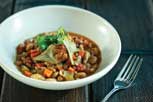
Chef Baker recently took their newest item – a red pea of African origin that predates the black-eyed pea – for a spin in Gather’s kitchen. He planned for it to accompany a goat dish, but the pea’s sweet and smoky gravy was so tasty that he was compelled to make it a new dish on its own.
Still, Baker doesn’t feel heirloom varieties require special treatment, they just tend to inspire new dishes. His enthusiasm has translated into unique menu creations where heirlooms run the show, like his assortment of vegan “charcuterie,” which boasts varieties like purple haze carrots (which harkens back to the vegetable’s original color in the wild) and romanesco broccoli (a centuries-old Italian variant of broccoli and cauliflower).
In the protein department, Lowe has seen truly unique utilizations of heritage meat at Cochon 555 events. One of his favorite discoveries hailed from the Bay Area. “It came from Chris Cosentino,” Incanto’s illustrious chef noted for his work with offal. “He made this dish called Chilibones, where he steamed and fried all the bones of the animal. Nothing went to waste. It was the most flavorful and probably the best utilization of a heritage animal I’ve ever seen.”
A tough sell?
Though exciting for the chef, heirloom and heritage varieties bring certain challenges. For Bienaimé, the most important is not overwhelming Marché’s customers. “I would rather cook something different everyday, but it’s generally not what consumers want. To accommodate, this Fall I offered a different squash soup every month to give just a taste of variety.”
In the face of similar challenges, Baker uses staples on Gather’s menu, like burgers and pizzas, as a foundation for dishes that introduce heirlooms in a more approachable way. “I’ll add a micro-seasonal twist to the dish, whether it’s squash on pizza or particular varieties of onions on a burger.”
Another challenge is advertising heirloom selections on the menu. At La Jolla’s A.R. Valentien, waiters talk about “farm to table” when presenting the evening’s menu, but Chef de Cuisine Tim Kolanko notes a trade-off in providing every detail about heirloom varieties. “It’s about giving just enough that consumers get excited.”
Though bursting with heirloom options, A.R. Valentien’s menu is selective in listing them. Their octopus dish is proudly paired with “heirloom” shell peas, piquillo peppers, olives, winter cress and preserved lemon, but other entrées are mum on heirlooms. On the day’s prix fixe menu, information is minimal but still makes note of heirloom items.
San Francisco Bay Area food visionaries Ari Derfel and Eric Fenster, co-owners of Gather, also decided to avoid inclusion of every purveyor on the restaurant’s menu; instead presenting simplified dish descriptions on their bill of fare. In order to educate diners and support their producers, Gather’s team brought on David Corson-Knowles to write the Source Book, an in-depth compilation of every purveyor that contributes to Chef Sean Baker’s cuisine – available for guests to read upon request.
Bienaimé mostly discusses origins, not varieties, on the menu. “The stars of our dishes are advertised by their origin. Beyond that, we have a monthly newsletter where I talk in depth about our sourcing.” Regardless of how much his customers care, Bienaimé says, “It’s mostly about transparency. I think it’s my job to educate people.”
Just have fun
By their very nature, heirlooms and heritage breeds offer a chef limitless media for experimentation. Lowe sees duck as a new frontier in heritage breeds. “With all duck’s wild breeds, it’s just the most amazing, flavorful species. The fun of understanding the animal’s region, its migratory patterns, what it eats – it’s just a blast. There’s so much for chefs to have fun with.”
And that seems to be the bottom line for reviving the heritage of, well, heritage. “Cooking this way,” says Baker, “makes my job more fun.”
Alicia Harvie has been actively involved in food and farm issues for years now and has a strong interest in creative “farm to table” linkages in culinary culture. She also loves any and all things chocolate. When not freelancing, Alicia works as the Program Manager for Farm Aid (www.farmaid.org), where she pens its “Ask Farm Aid” column each month. Farm Aid’s mission is to build a vibrant family-farm centered system of agriculture in America. Alicia can be reached at alicia.harvie@gmail.com.


From farmer Steve Sando: The seeds of Rancho Gordo were literally planted in a grocery store here in Napa. I was shopping one August for tomatoes and despite being in one of the world’s most magnificent agricultural regions, all the tomatoes were from a hothouse in Holland! Worse, they were hard and pale pink instead of the ripe tomatoes I was craving. I started to grow my own tomatoes and this eventually led to beans.
Heirloom beans are the foundation of Rancho Gordo. I remember the first time I ate a Rio Zape and was shocked at how much better it was than the average pinto bean. I did a little more research and soon realized that I hadn’t even scratched the surface. There are hundreds of heirloom beans waiting to be discovered. My thinking is the best way to save these beans is by eating them and letting people see that even though the yields are lower and they aren’t as uniform as industrial red kidneys, they are more than worth the bother.